
Part 3 of 5 in the Sweet Spot Framework series.
Most conversations about agency fees happen in a straight line. More money, better work. Less money, worse work. It’s intuitive. It’s also wrong.
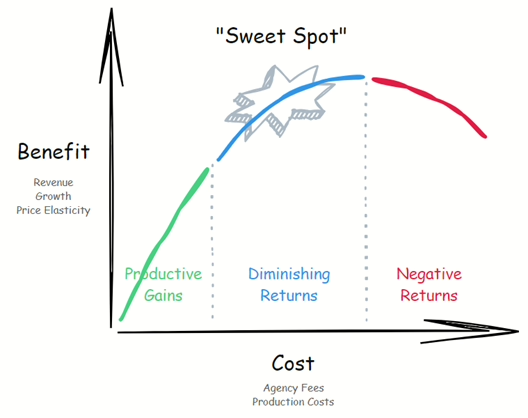
At its core, the Sweet Spot Framework uses a well-known business hypothesis, the ‘Law of Diminishing Returns’, as its foundation. What this means in our context is that the relationship between agency fees and marketing outcomes is not linear. Instead, it follows a logarithmic curve, shaped by the general law of diminishing returns. This law states that as investment in an input increases, the incremental gains in output eventually decrease, assuming other factors remain constant.
That principle changes how you should think about every scope negotiation, every budget conversation, and every fee benchmark.
Three Zones on the Curve
As the framework applies to our domain, the curve demonstrates how marketing campaigns and deliverables benefit from investments in resources, like time, talent, and senior oversight. There are three distinct zones:
Productive Gains. Allocating enough budget to fund essential work, such as research, strategy development, and ideation of the core creative concepts, yields significant improvements in quality and effectiveness. This is where every dollar works hard.
Diminishing Returns. Adding more budget to fund refinements, such as extra rounds of revisions, and additional senior input delivers noticeable but smaller improvements. You’re still getting value, but the rate of return is declining.
Negative Returns. Beyond a certain point, additional fees yield diminishing returns. For example, including multiple extra iterations or adding more senior resources, may not provide proportional benefits. You’re now paying more for overstaffing, duplicative research, or over-polishing with no meaningful impact.
What This Looks Like in Practice
To bring this to life, let’s look at some pragmatic examples of the curve in action.
Take a brand strategy campaign. A $100K investment might fund a basic strategy process, including competitor analysis and audience insights. Increasing to $125K allows for deeper research, multiple stakeholder workshops, and more senior strategic agency resources which lead to better results. But at $150K, the additional budget might only add unnecessary complexity, overstaffing or duplicative research. In this case the funds do not provide a meaningful increase in impact.
Now consider a creative production deliverable. An initial $15K investment might deliver basic creative assets with minimal polish. By taking the spend to $25K, the assets are far more refined and tailored for maximum impact. But increasing to $35K only adds unneeded additional iterations and “extras” that only marginally improve quality.
In both cases, there’s a range where the investment is working hardest. That range is the Sweet Spot.
The implication for procurement is clear: the question shouldn’t be “how low can we get this fee?” It should be “where on the curve does this investment sit, and is it in the right zone?”
Next in the series: why the Sweet Spot isn’t a fixed number, and how deliverable complexity, seniority, and AI are shifting where the optimal investment range sits.